












Patner With C4AIK To Streamline Employee On-boarding While Boosting Performance
A new hire’s first days can shape months of performance. When onboarding is clear, organized, and relevant, employees understand their role faster, build confidence sooner, and make better decisions with less supervision. When it is rushed or inconsistent, the opposite happens. Managers repeat the same explanations, new staff miss key details, and productivity takes longer to build.
Many organizations know onboarding matters, but they struggle to give it the time it deserves. Daily operations, customer needs, deadlines, staffing gaps, and compliance requirements often compete for attention. As a result, orientation becomes a checklist instead of a guided experience.
Partnering with C4AIK helps solve that problem. With the right onboarding and orientation support, organizations can give new employees a smoother start while freeing internal teams to focus on core business requirements.

Strong onboarding turns first impressions into lasting performance
Onboarding is more than paperwork, logins, and a quick tour. It is the process that helps employees understand how to succeed in a new environment. That includes culture, expectations, systems, safety rules, communication norms, job duties, and performance standards.
When onboarding works well, new employees do not have to guess what matters. They receive the right information at the right time, in a format they can absorb. They know whom to contact, where to find resources, and how their work connects to larger goals.
That clarity has a direct effect on job performance.
A strong onboarding process can help new hires:
Understand role expectations sooner
Build stronger work habits from the start
Avoid common mistakes caused by unclear instructions
Feel more confident asking questions
Develop trust with supervisors and peers
Contribute meaningfully in less time
The first few weeks are also when many employees decide whether an organization is organized, supportive, and worth committing to. A confusing start can weaken engagement before the real work begins. A structured start can build momentum.
C4AIK supports this process by helping organizations create a more consistent, guided, and practical onboarding experience. Instead of leaving each manager to build their own approach from scratch, C4AIK can help turn orientation into a clear process that supports both the employee and the business.
That consistency matters. If one employee receives detailed training while another receives scattered instructions, performance gaps appear quickly. A well-planned onboarding partner helps reduce those gaps by making the experience more dependable across roles, departments, and locations.
Time constraints often weaken the onboarding experience
Most organizations do not neglect onboarding because they do not care. They struggle because time is limited.
Managers balance hiring, operations, customer service, reporting, problem solving, and team performance. HR teams often manage recruitment, documentation, benefits, compliance, employee relations, and policy updates at the same time. When a new employee starts, the intention may be to provide a complete orientation, but urgent tasks interrupt the plan.
This creates common onboarding challenges:
Important information gets delivered too late
Training depends too heavily on one busy person
New hires receive too much information at once
Follow-up conversations get postponed
Policies are explained inconsistently
Employees learn through trial and error instead of guidance
These issues may seem small at first, but they can create real costs. A new employee who does not understand a process may make avoidable errors. A manager who must explain the same task repeatedly has less time for strategic work. A team member who feels unsupported may disengage before reaching full potential.
C4AIK can reduce this burden by helping organizations organize onboarding activities into a clear and repeatable flow. That does not remove the human side of onboarding. It supports it.
Instead of expecting managers to remember every step, C4AIK can help create a process that guides what happens before day one, during orientation, throughout the first weeks, and beyond. This makes onboarding less dependent on memory and more connected to a reliable structure.
The goal is simple: make onboarding easier to deliver without making it feel generic.

C4AIK helps create a smoother path from orientation to contribution
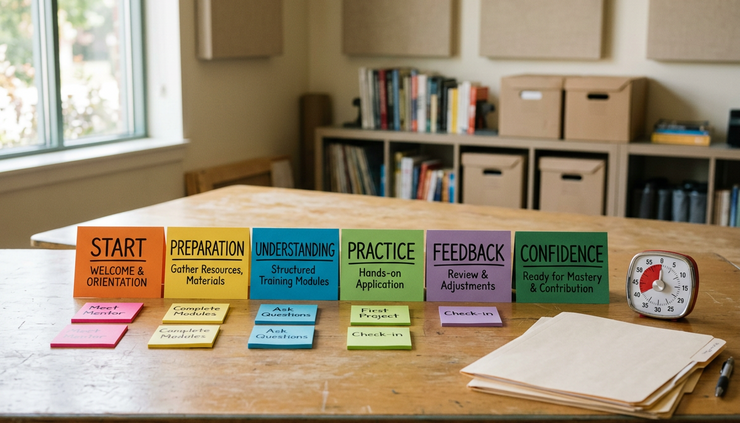
A well-built onboarding program should not overwhelm employees. It should break the experience into stages. Each stage should answer the questions that matter most at that moment.
On day one, an employee needs basic direction and a sense of welcome. During the first week, they need role context, tools, procedures, and support. Over the first month, they need feedback, practice, and a clearer understanding of performance expectations.
C4AIK can help organizations shape this journey so employees move from introduction to contribution with fewer obstacles.
A clearer pre-boarding experience sets the tone
Onboarding starts before the first day. New employees often have practical questions before they arrive. They may need to know what documents to bring, what tools they will use, what schedule to expect, and how to prepare.
When organizations handle this early, the first day feels less stressful. Employees arrive with fewer unknowns and more confidence.
C4AIK can support pre-boarding by helping organizations prepare clear communications, task lists, role-specific information, and resource access. This helps prevent the common first-day problem of spending hours on basic logistics that could have been handled earlier.
Orientation becomes easier to follow
Orientation should introduce the organization in a way that is useful, not overwhelming. New staff need to understand policies, values, expectations, communication channels, and workplace practices. If too much information comes at once, they may remember very little.
A structured partner can help organize orientation content into clear sections and practical steps. This makes it easier for employees to absorb information and easier for managers to deliver it.
That structure may include:
A standard welcome sequence
Role-based training paths
Clear checklists for required tasks
Short learning modules or guided resources
Follow-up points for supervisors
Easy access to reference materials
The value is not just in having materials. The value is in the order, timing, and relevance of those materials.
Role-specific training improves early performance
General orientation helps employees understand the organization. Role-specific training helps them do the work.
C4AIK can help connect onboarding content to the actual responsibilities of each position. This is where performance gains become more visible. Employees need to know what good work looks like, which tools to use, what standards apply, and how success will be measured.
When onboarding includes practical role guidance, new staff can begin contributing with greater accuracy. They are less likely to rely on assumptions and more likely to follow the organization’s preferred methods.
For example, a customer-facing employee may need scripts, escalation steps, product knowledge, and service standards. An operations employee may need safety procedures, workflow training, quality checks, and reporting expectations. A remote employee may need guidance on communication habits, security practices, and collaboration tools.
C4AIK can help organize these needs in a way that fits the role rather than treating every employee the same.
A strong partner protects internal focus
Onboarding takes time, but so does running the organization. Leaders must keep attention on customers, service delivery, operations, growth, compliance, and financial health. When onboarding absorbs too much internal capacity, other priorities can suffer.
This is where a partnership becomes valuable.
C4AIK can take much of the planning pressure off internal teams by helping build and manage the structure behind onboarding. That can include organizing content, improving orientation flow, supporting consistency, and helping teams identify gaps in the current process.
The result is not less involvement from leaders and managers. Their involvement still matters. New hires need connection, feedback, and context from real people inside the organization. The difference is that managers do not have to carry the entire onboarding system alone.
A practical onboarding partner allows internal teams to focus on the work only they can do:
Set expectations for the role
Build personal connection with the employee
Explain team goals and priorities
Provide feedback on early performance
Reinforce culture through daily behavior
Address role-specific questions
C4AIK supports the framework around those moments. This creates a better experience for everyone involved.
The best onboarding process does not compete with core business work. It supports it by helping new employees become capable, confident contributors sooner.
For organizations with limited time, this support can make a major difference. Instead of building orientation materials only when a new hire is about to start, teams can rely on a more prepared system. Instead of rushing through explanations, they can follow a planned sequence. Instead of correcting mistakes later, they can prevent many of them early.
Better onboarding supports retention, confidence, and accountability
Performance is not the only outcome affected by onboarding. A better onboarding process also supports retention and accountability.
Employees who understand their roles are more likely to feel capable. Employees who know where to find help are less likely to feel isolated. Employees who receive clear expectations are more likely to take ownership of their work.
This matters because early uncertainty can create frustration. New staff may wonder if they are doing well. Managers may assume something has been explained when it has not. Teams may expect a new employee to perform before they have received the right support.
C4AIK helps close these gaps by making onboarding more visible and measurable. When the process is mapped out, it becomes easier to see what has been completed, what still needs attention, and where the employee may need more help.
Managers gain a clearer view of progress
A structured process gives managers better insight into each new hire’s development. They can see whether orientation tasks are complete, whether training milestones have been met, and whether follow-up conversations are happening on time.
This makes performance management more fair and more useful. Instead of waiting for problems to show up, managers can address questions early.
Employees know what success looks like
New employees should not have to guess how to succeed. A strong onboarding process gives them clear signals.
They should understand:
What tasks to master first
Which policies affect their work
How communication should happen
Where to find help
What quality standards apply
How their performance will be reviewed
This kind of clarity builds confidence. It also helps employees become accountable for their own progress.
Teams benefit from consistency
When every new hire receives a different onboarding experience, team performance becomes uneven. Consistency helps reduce that risk.
C4AIK can help organizations create a shared onboarding foundation while still allowing room for role-specific needs. That balance is key. Employees need common knowledge about the organization, but they also need training that fits their day-to-day work.
A reliable process helps teams bring people in without slowing down every time a new person starts.

What to look for in an onboarding partnership with C4AIK
A successful partnership should start with the organization’s real needs. Onboarding should not be copied from a generic template and applied without context. It should reflect the type of work employees do, the risks they need to understand, the tools they use, and the culture they are joining.
When working with C4AIK, organizations can benefit most by focusing on a few core areas.
Current onboarding gaps
Before improving the process, it helps to identify what is missing. Are new employees confused about policies? Do managers skip follow-ups? Are training materials outdated? Are different locations handling orientation in different ways?
A clear review can reveal where time is being lost and where employees need better support.
Role-based priorities
Not every employee needs the same onboarding path. Some information should be standard for everyone, but much of the training should match the role.
C4AIK can help separate universal orientation from role-specific learning. This keeps the experience focused and prevents information overload.
Simple delivery
The best onboarding process is one people will actually use. If it is too complex, managers may avoid it. If it is too vague, employees may not benefit.
A practical process should be easy to follow, easy to update, and easy to repeat.
Follow-up and reinforcement
Onboarding should not end after day one. New employees need check-ins, feedback, and reinforcement as they begin applying what they have learned.
C4AIK can help organizations plan these follow-up points so employees receive support when it matters most.
A better start creates a stronger workforce
Employee onboarding affects performance, retention, culture, and operational focus. When it is rushed, inconsistent, or under-supported, both employees and managers feel the strain. When it is clear and well managed, new staff integrate faster and contribute with more confidence.
C4AIK helps organizations turn onboarding and orientation into a more organized, repeatable, and useful experience. That support is especially valuable for teams facing time constraints. Internal staff can stay focused on core business requirements while new employees receive the structure and guidance they need to succeed.
A strong onboarding partnership does more than improve the first day. It builds the foundation for better performance long after orientation ends.



Comments